|
Things you should do
|
Remind any doctor or pharmacist you visit that you are using Iopidine.
Keep all your doctor's appointments so that your progress can be checked.
|
|---|---|
|
Things you should not do
|
Do not stop using this medicine or lower the dose without first asking your doctor.
If you stop using your medicine your condition may worsen.
|
|
Driving or using machines
|
You should not drive, operate machinery or perform tasks requiring mental alertness
and/or physical coordination as you may feel dizzy or tired after using Iopidine.
|
|
Addiction
|
There is no evidence that Iopidine is addictive.
|
|
Looking after your medicine
|
Store below 25°C. Do not freeze.
Keep the bottle in the carton to protect the drops from light.
Do not leave the top off the bottle for any length of time, to avoid contaminating
the eye drops.
|
Warnings
Check with your doctor if you:
Pregnancy and breastfeeding
Use in children
Use in older adults
How much to use
When to use Iopidine
How to use Iopidine
1. Wash your hands well with soap and water.
2. Immediately before using a bottle for the first time, break the safety seal around the neck area and throw the loose plastic ring away.
3. Remove the cap.
4. Hold the bottle upside down in one hand between your thumb and middle finger (see Diagram 1).
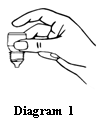
5. Tilt you head back and look up.
6. Using your other hand, gently pull down your lower eyelid to form a pouch/pocket.
7. Place the dropper tip close to, but not touching, your eye. Release one drop into the pouch/pocket formed between your eye and eyelid by gently tapping or pressing the base of the bottle with your forefinger (see Diagrams 2 and 3).
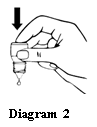
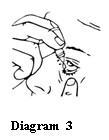
8. Close your eye. Do not blink or rub your eye.
9. While your eye is closed, place your index finger against the inside corner of your eye and press against your nose for about two minutes.
10. This will help to stop the medicine from draining through the tear duct to the nose and throat, from where it can be absorbed into other parts of your body.
11. Replace the cap on the bottle, closing it tightly.
12. Wash your hands again with soap and water to remove any residue.
How long to use it
If you forget to use Iopidine
If you use too much Iopidine
by calling 13 11 26 in Australia, or 0800 POISON or 0800 764 766 in New Zealand
Things you should do
Things you should not do
Driving or using machines
Looking after your medicine
When to discard your medicine
Getting rid of any unwanted medicine
Less serious side effects
|
Less serious side effects
|
What to do
|
|---|---|
|
In or around the eye (ocular):
A feeling that the eye is dry or watery
Blurred vision and/or problems seeing clearly
Itchy eyes
Eye/eyelid redness
Discharge from the eye and/or crusty eyelashes
Discomfort, grittiness, irritation or pain in the eye(s)
Excessive sensitivity to bright light
Dilated pupils
Swelling to the front part of the eye
Difficult opening the eye
Eyelid swelling
Scales on or around the eyelid
Raising of the upper eyelid
Droopy eyelids
Conjunctiva (layer of skin between eyelid and eye) swelling.
Body as a whole:
Headache and/or feeling sick
Senses:
Changes in the sensations of taste and/or smell
Heart related:
Irregular heartbeat
Central nervous system:
Dizziness, tiredness, lack of co-ordination, fainting
Inability to sleep
Mood changes, such as depression, irritability or nervousness
Numbness or tingling in fingers or toes
Digestive system:
Dry mouth
Nausea and/or Constipation
Breathing:
Dry nose
Sore throat and/or runny nose
Muscle/bone related:
Aching or painful muscles, not caused by exercise
Skin:
Skin rash.
|
Speak to your doctor if you have any of these less serious side effects and they worry
you
|
Serious side effects
|
Serious side effects
|
What to do
|
|---|---|
|
Allergic reaction
shortness of breath, wheezing or difficulty breathing, swelling of the face, lips,
tongue or other parts of the body, rash, itching or hives on the skin.
Allergic-like reaction
Redness and swelling of the eye(s), eyelid(s) and/or the areas surrounding the eye(s).
The eye(s) may become watery, itchy and uncomfortable, as though something is in them
Heart Related:
Chest pain
Swelling of the face, hands or feet
Breathing:
Wheezing, difficulty in breathing
|
Call your doctor straight away, or go straight to the Emergency Department at your
nearest hospital if you notice any of these serious side effects.
|
Reporting side effects
What Iopidine contains
|
Active ingredient
(main ingredient)
|
apraclonidine hydrochloride 5 mg in 1 mL (0.5%)
|
|---|---|
|
Other ingredients
(inactive ingredients)
|
benzalkonium chloride (as a preservative)
sodium acetate
sodium chloride
purified water
sodium hydroxide and or hydrochloric acid to adjust pH
|
|
Potential allergens
|
benzoates, sulfites and hydroxybenzoates.
|